
As 2025 comes to a close, we’re taking a moment to honor the wins—large and small—that reminded us progress is still possible. Here are a few feminist victories worth celebrating.


More Than A Magazine, A Movement

As 2025 comes to a close, we’re taking a moment to honor the wins—large and small—that reminded us progress is still possible. Here are a few feminist victories worth celebrating.
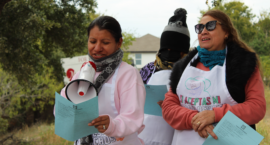
The hotel had become a place where women endured hellish conditions and were expected to stay silent.
They decided to break that silence.
***
More than 70 percent of hotel housekeepers in the United States are women. Their labor is the backbone of an industry that markets comfort but often denies dignity to those who create it. At Sonesta Select Austin North, the women who knew every hallway, every cart and every stain were treated as if they were disposable. What they experienced is a common issue when those doing the hardest work have the least power.
(This essay is part of a collection presented by Ms. and the Groundswell Fund highlighting the work of Groundswell partners advancing inclusive democracy.)

Since Trump’s inauguration in January, we’ve seen a barrage of attacks on the rights of women, immigrants and undocumented people, people of color and LGBTQ+ people. The cruelty that the administration has shown has been astounding to witness.
But the resistance to this cruelty has been just as astounding. Millions taking to the streets, again and again. Neighbors stepping in and preventing ICE from kidnapping neighbors they may not even know. Democracy defenders taking to the courts, fighting the onslaught of unconstitutional executive actions. Courageous networks of doctors, nurses, midwives and regular people distributing abortion pills into red states and ensuring women have access to safe abortion no matter where they live. And of course, the major feminist victories in November’s elections—in which women made a decisive difference for our democracy.

Months before the lives of West Virginia National Guard Specialist Sarah Berkstrom and Afghan asylee Rahmanullah Lakanwal collided, the Trump administration planned to bring immigration to a halt from countries like Afghanistan, Somalia, and other nations that supposedly threaten American values. When Lakanwal was charged with first-degree murder in Berkstrom’s Nov. 26 death, the administration seized on this tragedy to redouble its rhetoric against Afghans and others and to usher in the next round of immigration restrictions.
As Spojmie Nasiri, an Afghan American immigration attorney points out, “They are using the tragedy to enact the agenda that they already had.”
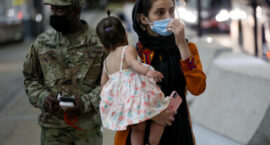
The shooting in Washington, D.C., that left one National Guard member dead and another critically wounded on Nov. 26 quickly became a major focus of U.S. media. In the days since the shooting, the national conversation has focused almost entirely on the suspect’s identity as an Afghan refugee. Yet those who knew him describe a man who appeared to be struggling long before he drove across the country to Washington, D.C. One volunteer who worked closely with his family said he became increasingly withdrawn, isolated and overwhelmed by the challenges of resettlement. They noted that his behavior reflected profound distress, not radicalization or hostility toward the United States.
Despite these documented struggles, the current administration immediately cast the shooting as a failure of vetting by the Biden administration and threatened to punish an entire community for the crime of one individual. That framing ignores the basic fact that the suspect had been vetted repeatedly. It also ignores the testimony of those who interacted with him in the U.S. and saw no signs of ideological motivation.
Internal directives show ICE has begun targeting more than 1,800 Afghans with past deportation orders and is tracking arrests and removals in daily reports. Officials are also reassessing Afghan vetting programs created after the 2021 withdrawal, despite the fact that the suspect himself was granted asylum during the Trump administration after already receiving extensive screening.
The policies signal a retreat from those commitments and send a dangerous message to future partners: Support for the United States may not translate to safety once U.S. needs are met.
The tragedy in Washington stands as a devastating loss. It deserves a full investigation and a clear accounting of what shaped the suspect’s unraveling. But it must not be used to justify policies that abandon allies, ignore humanitarian obligations and dehumanize an entire community.

Weekend Reading for Women’s Representation is a compilation of stories about women’s representation in politics, sports and entertainment, judicial offices and the private sector—with a little gardening mixed in!
This week:
—The 2025 elections prove that voters across the country want women as their leaders.
—Democratic leaders are exploring ranked-choice voting for the 2028 presidential primaries.
—In a Tennesee special election, Democratic nominee Aftyn Behn surpassed electoral expectations for her congressional district.
—Fort Collins, Colo., elected Emily Francis as mayor in its first use of ranked-choice voting.
—College student Any Lucía López Belloza was deported in Massachusetts on her way home to Texas for Thanksgiving.
… and more.

MAGA Republicans are back in the White House, and Project 2025 is their guide—the right-wing plan to turn back the clock on women’s rights, remove abortion access, and force women into roles as wives and mothers in the “ideal, natural family structure.” We know an empowered female electorate is essential to democracy. That’s why day after day, we stay vigilant in our goals to dismantle patriarchy at every turn. We are watching, and we refuse to go back. This is the War on Women Report.
Since our last report:
—North Dakota’s Supreme Court reinstated a total abortion ban, making it the 13th state with a near-total ban on abortion.
—Trump ordered Catherine Lucey, a woman reporter for Bloomberg, to be “quiet, piggy.”
—The U.S. moved to categorize countries with state-sponsored abortion and DEI policies as violators of human rights.
—Florida Attorney General James Uthmeier has sued Planned Parenthood over allegedly “misrepresenting the safety” of abortion pills.
—On Thursday, Dec. 4, an unprecedented law banning doctors from shipping abortion pills takes effect in Texas.
—”The country’s most respected newspaper hosted a conversation about whether women’s equality and freedom was a mistake.”
—Doctor Maj. Blaine McGraw, an OB-GYN at Fort Hood military base in Texas, the third-largest base in the country, is under investigation for sexual abuse against patients. As of Monday, 85 victims have come forward.
—With Jeffrey Epstein survivors watching from the gallery above, the House agreed in a near-unanimous vote to force the release of all files related to the investigation of the convicted sex offender.
… and more.
For many Asian and immigrant families, caregiving is a way of life, with generations living and caring for one another under the same roof as part of daily life. My Iranian grandparents lived in a multi-unit dwelling in Tehran, where they cared for each other through illness and aging, cooking and sharing meals with their children and grandchildren in what seemed to me a seamless synchronicity. When my Pakistani grandmother emigrated from Karachi to the U.K. in the 1970s, she moved in with my uncle’s family, sharing a bedroom with her youngest grandson until she died. Now, that grandson lives in the same house with his own children and aging parents.
However, here in the U.S., caregiving takes on a very different form, even for families raised on the belief that caring for another is simply what we do.
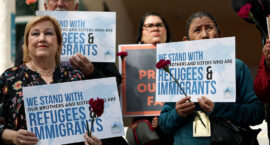
This month, Secretary of State Marco Rubio instructed visa officers to consider obesity and other chronic health conditions, such as heart disease, cancer and diabetes, as justification to deny people visas to the United States.
Many were outraged and shocked, observing the Trump administration’s new expansion of the “public charge” rule—directing visa officers to deny entry to people with disabilities, chronic illnesses or age-related conditions—as a modern revival of eugenic immigration policy designed to exclude, control and institutionalize disabled and marginalized people.
When Trump first took office in 2016, the Trump administration broadened the definition of public charge to include people who receive SNAP benefits, medicaid, housing assistance, childcare subsidies and more. This new rule was published in 2019 and went into effect in 2020 and early 2021; President Biden ended the use of this public charge rule definition in March 2021, returning it to the older but still restrictive version. Following Trump’s new rule, visa denials based on the “public charge” rule exploded during Trump’s first residency, rising from just over 1,000 denials in 2016 to over 20,000 in 2019, and it had disastrous effects.
As the Migration Policy Institute (MPI) found, broadening this public charge rule led many people to reduce or stop using benefits or services for themselves.

In every issue of Ms., we track research on our progress in the fight for equality, catalogue can’t-miss quotes from feminist voices and keep tabs on the feminist movement’s many milestones. We’re Keeping Score online, too—in this biweekly roundup.
This week:
—Democratic candidates won elections across the country.
—At Crooked Con last week, Rep. Pramila Jayapal (D-Wash.) laid out her priorities for when Democrats regain power in Congress: “We’ve got to fix the Voting Rights Act, we have to deal with the money in politics, we have to deal with the Supreme Court and we need immigration reform.”
—ICE targeted childcare workers and is accused of inhumane detention conditions.
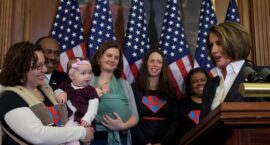
—Nancy Pelosi announced her retirement in 2027.
—Trump’s approval ratings continue to fall, a year out from the 2026 midterms.
—Many popular lubricants aren’t safe for vaginal health.
… and more.