How the Trump Administration Used a National Guard Tragedy to Accelerate Its Anti-Immigrant Agenda

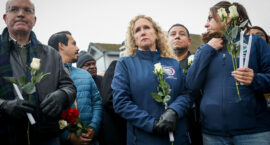
Months before the lives of West Virginia National Guard Specialist Sarah Berkstrom and Afghan asylee Rahmanullah Lakanwal collided, the Trump administration planned to bring immigration to a halt from countries like Afghanistan, Somalia, and other nations that supposedly threaten American values. When Lakanwal was charged with first-degree murder in Berkstrom’s Nov. 26 death, the administration seized on this tragedy to redouble its rhetoric against Afghans and others and to usher in the next round of immigration restrictions.

As Spojmie Nasiri, an Afghan American immigration attorney points out, “They are using the tragedy to enact the agenda that they already had.”

She Was an Antiabortion Poster Child. Now She’s a Reproductive Freedom Activist.

At the age of 15, Charlotte Isenberg took to social media to process complicated feelings about a miscarriage after alleged sexual abuse. That was what first brought her to the attention of antiabortion groups.

“Almost immediately, anti-abortion actors threaded a narrative for me between my grief, my miscarriage and anti-abortion sentiment. I clung to it with desperation,” Isenberg wrote.

Feeling isolated from peers due to both her traumatic experiences and the COVID-19 pandemic, Isenberg found a sense of belonging in these online spaces.

But in May 2024, at age 20, Isenberg says her birth control failed, and she became pregnant for the second time. The timing was devastating: She was unemployed, without stable housing or transportation, and preparing to relocate for college—the first in her family to access higher education. 

When she couldn’t find adequate support for her unplanned pregnancy, Isenberg scheduled an appointment at her local Planned Parenthood for an abortion consultation, unsure of what she would ultimately decide. Another prominent antiabortion activist, one of Isenberg’s best friends in the movement, found out about her appointment; she and other members of the group intervened aggressively.

Despite this pressure, Isenberg was able to make the decision that was best for her and her body. Since her own abortion, she’s become a reproductive freedom activist, educating others about extremist antiabortion tactics and promoting systemic protections for people navigating reproductive healthcare. 

For Women Spending the Holidays in Prison or a Shelter, You Can Make a Difference

Women and girls are the fastest growing incarcerated population in the United States today. The women now in prison are often there because of circumstances that might have put you or me there, too. 

We at Ms. magazine want women in prison to know they are seen and valued. And because domestic violence shelters can be almost as isolating as prisons—and often lack reading material, just as many prisons do—we want to support women in those shelters, too. 

For a tax-deductible donation of just $30, you can help send Ms. to a woman in prison or a domestic violence shelter for a year. And for just $10 more ($40 total), you can get a year’s worth of Ms. for yourself as well.

A Feminist Historian’s Year-End Reading and Viewing Guide

As the year winds down, I find myself returning—as I always do—to the stories, performances and ideas that have shaped my teaching and thinking. Feminism’s past is never really past; it’s a living archive we carry with us, full of unresolved questions, missteps, breakthroughs and beautiful, complicated people. This year’s reading and viewing list reflects that sensibility.

Liberation forces its contemporary narrator—and its audience—to reckon with the impossible expectations we’ve placed on small groups of women in church basements.

Molly Jong-Fast’s memoir presses on the tender, maddening ties between feminist foremothers and the daughters who grew up in their shadow.

Sarah Weinman’s study of spousal rape laws exposes just how recently the law stopped treating wives’ bodies as open territory—while showing how fiercely survivors and advocates have had to push for change that should never have been controversial.

‘This Is the Blind Spot in Extremism Research’: Cynthia Miller-Idriss on Misogyny, Gender and Violence

Cynthia Miller-Idriss, director of the Polarization and Extremism Research & Innovation Lab (PERIL) at American University, makes the connection between gender policing, misogyny and far-right extremist violence, which for many years was not a connection scholars were willing to make.

Jackson Katz and Miller-Idriss discuss her book, Man Up, on misogyny, gendered violence, the MAGA movement and far-right extremism. Miller-Idriss says political violence coming from the far-right includes gender policing and exploitation.

“These aren’t just opportunistic elements of extremism—they are deliberate, organized and large-scale forms of gendered violence aimed at increasing pain and humiliation of victims, witnesses and family members. … I’m still blown away by how few people will acknowledge the connection.”

Making the Invisible Visible: How Misogyny Is Driving Rising Political Violence

We have seen a rise in political assassinations and assassination attempts, along with violent extremist attacks that have ticked upward for years. Mass casualty plots in the U.S. have increased by over 2,000 percent since the 1990s, leading to the deaths or grievous injury of thousands of people in shootings at schools, grocery stores, theaters, parades, concerts, houses of worship and more.

In the search for explanations, the public and policy discourse is most often swept up in heated debates about far-left or far-right ideologies.

But the data shows that the biggest and clearest predictor of mass shootings, across ideologies, sits somewhere else: in rising gendered grievances, patriarchal backlash, and the perpetrators’ histories of gender-based violence and misogyny.

Sex, Power and Impunity: Epstein’s Legacy in Historical Perspective

The scandal that has preoccupied much of mainstream U.S. politics has, been, at one level, delightful: We have seen extremist Republicans—Reps. Marjorie Taylor Greene, Lauren Boebert, Thomas Massie and Nancy Mace—break with their party and its president in an effort to force into light the U.S. Department of Justice files on convicted sex trafficker and pedophile Jeffrey Epstein. 

The story is almost irresistible for critics of the current national administration, feminists among them: Will we finally get to items from Epstein like the CD labeled “girl pics nude book 4”? What might these materials reveal? And whose misbehavior might they reveal?  

Fire the starting gun on analyses from every liberal, left, critical corner. Claims abound of shifting coalitions, changing tides, pages turned, a president’s authority shredded. 

But there are still as many questions stirring in the Epstein pot as there are answers. Why did these particular Republicans break from the pack? Is this a contemporary Republican version of feminism? 

And beneath them all: What good does it actually do us—or Epstein’s particular victims, or the scads of other victims of sexual coercion, trafficking and other mistreatment—to raise the heat so high on this particular scandal?

War on Women Report: Antiabortion Extremist Charged in S.C. Shooting; Army OB-GYN Accused of Abusing Over 85 Women Patients

MAGA Republicans are back in the White House, and Project 2025 is their guide—the right-wing plan to turn back the clock on women’s rights, remove abortion access, and force women into roles as wives and mothers in the “ideal, natural family structure.” We know an empowered female electorate is essential to democracy. That’s why day after day, we stay vigilant in our goals to dismantle patriarchy at every turn. We are watching, and we refuse to go back. This is the War on Women Report.

Since our last report:
—North Dakota’s Supreme Court reinstated a total abortion ban, making it the 13th state with a near-total ban on abortion.
—Trump ordered Catherine Lucey, a woman reporter for Bloomberg, to be “quiet, piggy.”
—The U.S. moved to categorize countries with state-sponsored abortion and DEI policies as violators of human rights.
—Florida Attorney General James Uthmeier has sued Planned Parenthood over allegedly “misrepresenting the safety” of abortion pills.
—On Thursday, Dec. 4, an unprecedented law banning doctors from shipping abortion pills takes effect in Texas.
—”The country’s most respected newspaper hosted a conversation about whether women’s equality and freedom was a mistake.”
—Doctor Maj. Blaine McGraw, an OB-GYN at Fort Hood military base in Texas, the third-largest base in the country, is under investigation for sexual abuse against patients. As of Monday, 85 victims have come forward.
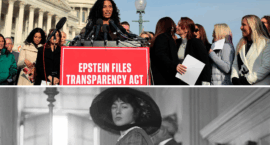
—With Jeffrey Epstein survivors watching from the gallery above, the House agreed in a near-unanimous vote to force the release of all files related to the investigation of the convicted sex offender.

… and more.

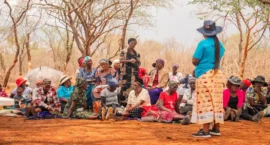
Breaking the Silence: Zimbabwe Initiative Reaches Survivors of Violence

For years, Tjedza endured sexual violence at the hands of her father. Clara, an elderly woman, experienced abuse at the hands of her son. And for most of Tabeth’s married life, she bore abuse at the hands of her husband. 

These abuses—and many more like them—went unseen for far too long. Yet in rural Zimbabwe, services to support survivors of gender-based violence are often out of reach. Survivors often must travel long distances to seek help, and when they do, they risk facing stigma and blame from the very responders who are meant to protect them.  

But today, for survivors like Tjedza, Clara and Tabeth, the years of fear and silence are over. 

An initiative in Zimbabwe’s Bubi District, known as Women at the Center, is improving access to essential protection and support services—and improving the quality and delivery of these services as well. Now, when one survivor receives respectful care and protection, others are emboldened to speak out too.

“I only got the confidence to report after seeing how other survivors had received care and were in a much better place,” Tjedza shared.

“This program didn’t just save my life; it gave me back my dignity,” said Clara.