

Disrupting Intimidation: How Texas Hotel Workers Are Shaking Up the Industry 

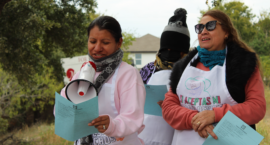
The hotel had become a place where women endured hellish conditions and were expected to stay silent.

They decided to break that silence.

***

More than 70 percent of hotel housekeepers in the United States are women. Their labor is the backbone of an industry that markets comfort but often denies dignity to those who create it. At Sonesta Select Austin North, the women who knew every hallway, every cart and every stain were treated as if they were disposable. What they experienced is a common issue when those doing the hardest work have the least power.

(This essay is part of a collection presented by Ms. and the Groundswell Fund highlighting the work of Groundswell partners advancing inclusive democracy.)

Project 2026 Declares Open War on Women’s Rights

When The Heritage Foundation released its new policy blueprint for 2026 this week—an extension of the now-infamous Project 2025—it did so with the calm confidence of an institution convinced no one will stop it. The document is shorter than last year’s 900-page “Mandate for Leadership,” but no less dangerous. It is, in fact, more candid.

Project 2026 lays out a government redesigned to control women’s bodies, erase LGBTQ+ lives, dismantle civil rights protections and roll back decades of hard-won progress. Wrapped in the language of “family,” “sovereignty” and “restoring America,” it is a direct attempt to impose a narrow, rigid ideology on an entire nation.

Make no mistake: This is a plan for forced motherhood, government-policed gender and the end of women’s equality as we know it.

But Project 2026 is not destiny. It is a warning—and one we must answer with the full force of a movement that has never accepted a future written for us by someone else.

Keeping Score: 137 Women Are Killed by Partners or Family Per Day; Bipartisan Push for Epstein Files; Trans Day of Remembrance and Native Women’s Equal Pay Day

In every issue of Ms., we track research on our progress in the fight for equality, catalogue can’t-miss quotes from feminist voices and keep tabs on the feminist movement’s many milestones. We’re Keeping Score online, too—in this biweekly roundup.

This week:
—137 women and girls are killed by intimate partners or family members every day.
—Congress votes overhwlemingly to force the Justice Department to release their Epstein files.
—Donald Trump snaps at women journalists: “Quiet, piggy” and “you are an obnoxious—a terrible, actually a terrible reporter.”
—Violence against trans women remains high.
—DACA recipients are being targeted and detained under the Trump administration.
—Higher-income college students often receive more financial support than they need, while low-income students struggle.
—Tierra Walker died from preeclampsia in Texas after being repeatedly denied an abortion.
—Viola Ford Fletcher died at age 111. She was the oldest living survivor of the 1921 Tulsa Race Massacre. 
—North Dakota’s total abortion ban was reinstated after the state’s Supreme Court reversed a temporary injunction from a lower court. There are now 13 states with total bans.

… and more.

They Came for Nurses. What They’re Really Coming for Is Women’s Power—and Your Healthcare

In a quiet regulatory maneuver with seismic consequences, the U.S. Department of Education—under the direction of Republican members of Congress—has proposed reclassifying all graduate nursing degrees as “non-professional.” What sounds like an obscure bureaucratic shift is, in reality, a direct attack on the women who make up nearly the entire nursing workforce and who hold together America’s fraying healthcare system.

The Politics of ‘Audit’: How Texas Is Using Bureaucracy to Erase Gender Studies

Professor Melissa McCoul was dismissed in September after teaching LGBTQ+ themes in her children’s literature course at Texas A&M. Just this week, a faculty council determined McCoul’s firing violated her academic freedom.

But politicians and activists who oppose what they call “woke gender ideology,” are galvanized and doubling down, using this Texas A&M case to push for curricular reviews aimed at eliminating women’s, gender and sexuality studies from public colleges and universities across Texas.

Framed as bureaucratic oversight, conservatives seek to eliminate gender studies and related fields through procedural mechanisms that evade public scrutiny. The assaults on gender studies in Texas are not just a local issue; they are a national bellwether. They signal a coordinated effect to dismantle feminist and queer inquiry and remind us that silence, in the face of repression, is complicity.

When the Headline Gets It Wrong: Feminism Isn’t the Problem—Patriarchy Is

When I saw the headline “Did Women Ruin the Workplace? And if So, Can Conservative Feminism Fix It?” in The New York Times Opinion section, my heart sank. It felt like a headline torn from another era—a provocation that had no place in 2025.

False accusations remain extremely rare—estimated at between 2 percent and 8 percent of reports—while roughly two-thirds of sexual assaults are never reported at all. The crisis is sexual violence, not accountability.

Yet, for centuries, women have been labeled “emotional” or “petty” to justify their exclusion from leadership and public life. Hearing these stereotypes revived in 2025—in The New York Times, no less—is disheartening. At a time when reproductive rights are being stripped away and women’s autonomy is under attack, we don’t need pseudo-intellectual nostalgia for patriarchy disguised as debate. We need truth, solidarity and progress.

The message from the writers is clear: Women should know their place. But women already do—it’s everywhere decisions are made, everywhere power is exercised, everywhere the future is being built. We’re not staying in our lane. We made the road. And we’re not going anywhere.

Complying With Trump Administration’s Attack on DEI Could Get Employers Into Legal Trouble

Since the Trump administration made diversity, equality and inclusion “immoral” and “illegal,” a large part of workplace discrimination in the country still remains to be experienced by women and members of racial minority groups. Now, these groups have less of a platform to make complaints about such discrimination.

Tools of the Patriarchy: How Communication Double Standards Silence Women

“Sorry, but—”

I paused as the words flew from my mouth, forming an apology before I could even consider why I felt the need to begin my confrontation with one. A moment earlier, my friend had interrupted me during a heated debate, and I wanted to finish making the point I had been in the middle of.

“No worries, it’s all good,” he said with a smile, continuing with his argument. I sat stunned by how in a matter of seconds, I had been interrupted, then enabled to apologize for trying to address the interruption—all with the end result of my friend getting to speak over me.

These types of interactions happen to women all the time. Compulsive apologies, interruptions, mansplaining and emotional weaponization are all barriers that get in the way of women getting their point across, and being heard.

Communicating is already complicated enough, but it is even more difficult as a woman—so let’s talk about it.

Over a Million Women Are at Risk of a Pay Cut Under a New Trump Rule

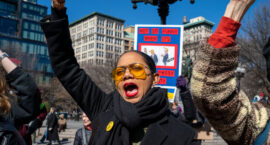
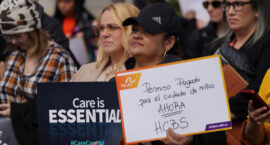
The Trump administration’s Department of Labor recently proposed a new rule that would directly take earnings away from the more than 1.5 million home care workers in the United States, more than 80 percent women, and their families.

Between 2019 and 2040, the population of adults ages 65 and older is expected to balloon from 54 million people to nearly 81 million people, comprising an estimated 22 percent of the U.S. population. That means that the direct care workforce is projected to grow at a faster rate than any other occupation over the next decade.

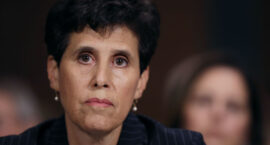
‘We Have to Be Relentless’: #MeToo Champion Debra Katz Is Confident ‘There Will Be Wins’ for Survivors in the Days Ahead

In the latest episode of Looking Back, Moving Forward, “the feared attorney of the #MeToo movement” assesses the legal landscape facing survivors—and how activists can continue to hold people in power accountable.

Listen to the latest episode of Looking Back, Moving Forward, “How Feminists are Breaking the Cycle of Gender-Based Violence and Harassment (with Ellen Sweet, Jane Caputi, Vanessa Tyson, Victoria Nourse, and Debra Katz)” on Spotify, Apple Podcasts or wherever you get your podcasts.